The Balloon Sword - An AI Filmmaking Experiment

Updated: Jun 3
The Balloon Sword was my first experiment in AI-driven filmmaking.
Watch the film in 4K on YouTube.
Rather than spending months studying tools and tutorials, I wanted to learn by building something tangible. This short film was created over a few evenings after work and a weekend of exploration, allowing me to test ideas, workflows, and the current capabilities of AI within a small, manageable project.
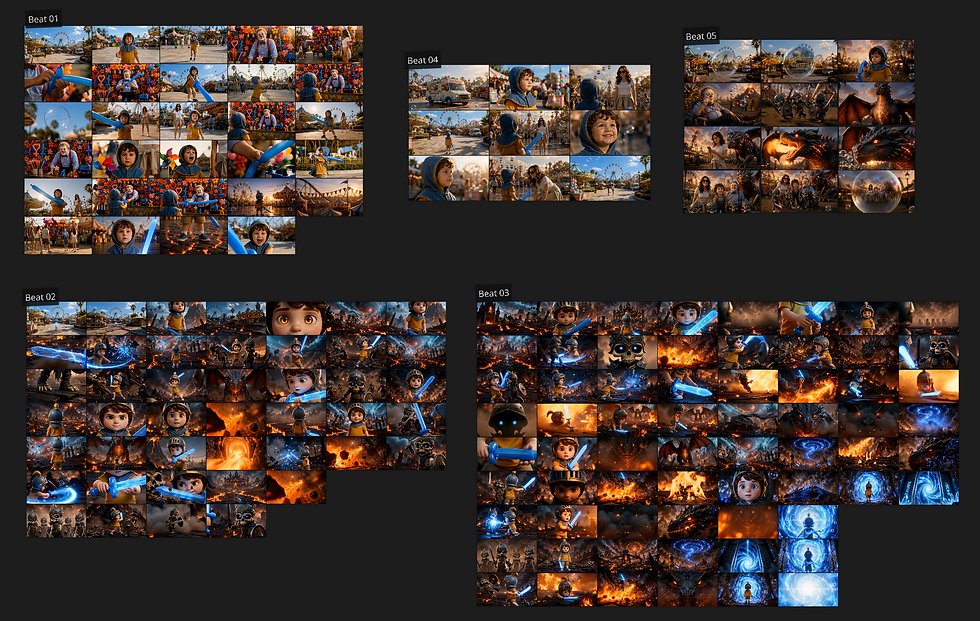
The story itself is intentionally simple. It follows a three-act structure with five key emotional beats. My creative process began with moodboards, as I tend to think through color, atmosphere, and emotion before designing individual shots. For the real-world sequences, I used a warm analogous color palette to create a sense of familiarity and safety. As the story progresses, the palette gradually shifts toward complementary colors to introduce tension, uncertainty, and conflict.
One of the biggest lessons from this project was realizing how many limitations still exist within current AI filmmaking tools. Despite the excitement surrounding AI-generated content, creating a film is far from a one-click process.
The area I found most challenging was cinematography. While AI can generate visually impressive imagery, it often struggles with realistic lens behavior, intentional framing, and visual storytelling principles. Characters frequently appear centered in the frame, and achieving purposeful camera language requires significant iteration and guidance.
Post-production also played a major role in the final result. A substantial amount of time was spent refining color, balancing shots, and reducing what many creators refer to as the “AI look.” Current AI-generated footage often exhibits compressed contrast, limited dynamic range, and inconsistencies between shots, making finishing work an essential part of the process.
More than anything, this project was an opportunity to explore where AI currently fits within the filmmaking pipeline. It helped me better understand both the strengths and limitations of these emerging tools while continuing to apply principles from traditional visual effects, cinematography, and storytelling.
I look forward to connecting with others who are exploring AI filmmaking, visual effects, and cinematic storytelling.


Comments